 MemeReply
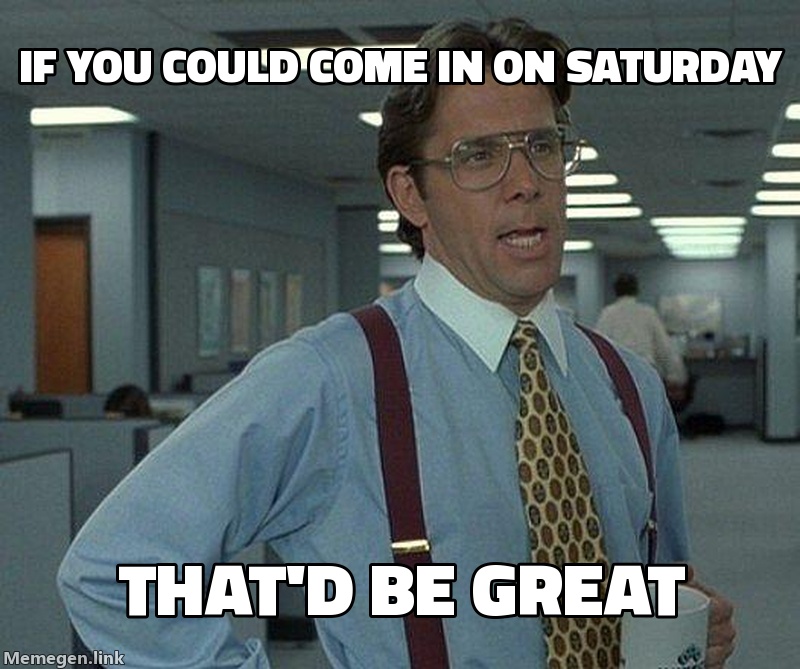
Meme template · 2 text boxes
That Would Be Great meme
Bill Lumbergh from Office Space: "Yeah... that'd be great." Polite, passive-aggressive requests.
Where it comes from
That Would Be Great is Bill Lumbergh, played by Gary Cole, in the 1999 film Office Space. He stands in a cubicle doorway with a mug and asks for something unreasonable in the mildest voice he owns. The line people repeat is the padding around the ask: "yeah," "if you could," "that'd be great." The film is a comedy about a soul-crushing software office. Lumbergh is the manager who has never personally felt the weight of the favor he is requesting. The meme took the padding and left you to insert the favor.
Two boxes. The first is the request, often starting with "if you could," because that is how he pretends the request is optional. The second is the soft landing, "that'd be great," "yeah," or another piece of corporate velvet. The stock example is just the velvet: "yeah..." and "that'd be great." Your version should put the actual imposition on top and the velvet underneath, so the contrast is visible. "If you could come in on Saturday / that'd be great." The Saturday is the knife. The second line is the napkin.
He is not angry. Captions that shout waste him. The joke is the temperature. A furious demand for weekend work is just a bad boss. A gentle demand for weekend work, phrased as a tiny favor, is Lumbergh.
How people use it
Reply with him when a post, an email, or a chat message dresses a large ask as a small one. "Quick question" that is a project. "Hopping in" that means your evening. "Friendly reminder" that is the third reminder. You translate it into his dialect so the size of the ask and the softness of the tone sit in separate boxes. People who have had a job recognize the doorway.
It is a narrow costume. It wants an institution: a boss, a client, a building chat, a professor, a group project. Used on a friend who straightforwardly asked for help, the mug and the pause turn a normal request into an accusation of corporate slime. If the ask was direct, let it be direct, and pick a template that can be grateful or funny without implying a performance review.
Write the first line as the thing they actually want, with the minimizing adverb still attached if they used one. "If you could just rewrite it real quick." Leave "real quick" in. The minimizing is evidence. The second line should not add a new demand. It closes the door softly. "That'd be great." "Thanks so much." "Whenever you get a sec." If the second line contains another task, you have written a to-do list, and he only came in to assign one.
The film is specific and the actor is specific. You do not need to explain who he is if the cadence is right. The cadence is "if you could" plus a thing nobody wants to do plus "that'd be great."
When to reply with it
- Extra work on a Friday
- Weekend requests from the boss
- Corporate politeness
Example captions
- If you could come in on Saturday
- that'd be great
- yeah...
- that'd be great
- If you could come in on Saturday
- that'd be great
The imposition goes on top, in his optional-sounding voice. The second line is only the velvet, not a second task.
- Yeah, if you could just rewrite the deck tonight
- that'd be great
Keep the minimizing words. 'Just' and 'tonight' are the joke. The landing stays soft.
- If you could go ahead and fix production
- that'd be super
The favor is enormous. The closer pretends it was a courtesy. Do not let the second line shout.
- Whenever you get a sec, the whole migration
- yeah...
A casual clock on top of an uncasual job. The bottom line can be the murmur instead of the catchphrase.
Each line goes in one text box, in order. In the editor, AI suggests captions written for the post you are replying to, and you can change every word.
The blank template

Where it comes from: knowyourmeme.com. Template images can carry their own rights; see template rights.