 MemeReply
Meme template · 2 text boxes
X, X Everywhere meme
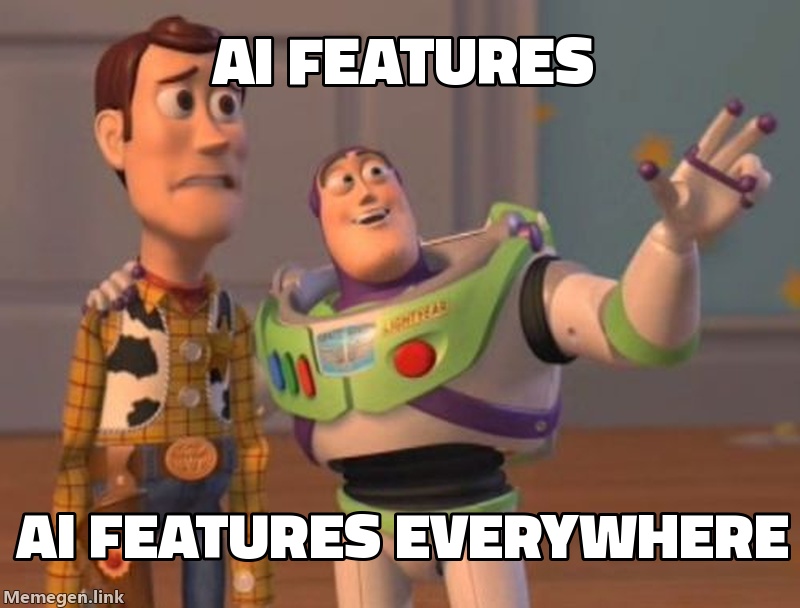
Buzz Lightyear points to the horizon while a worried Woody looks on: "X, X everywhere." Something is suddenly unavoidable.
Where it comes from
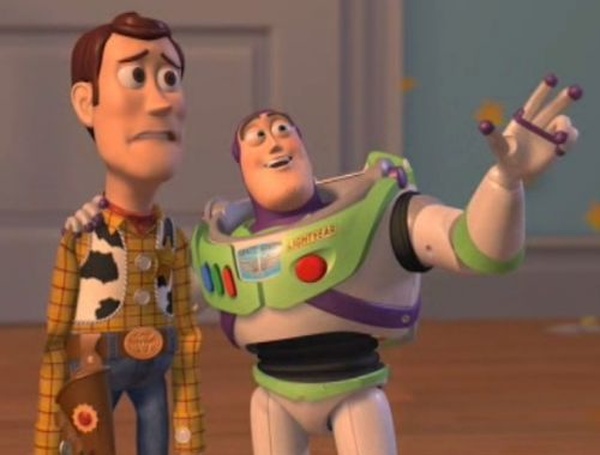
X, X Everywhere is a still from Toy Story. Woody stands to one side looking worried. Buzz Lightyear, in the space-ranger suit, points out toward the horizon as if he is naming a landscape. The meme puts a noun in his mouth twice: once as the thing, and once as the thing that has covered the map. The usual wording is "X, X everywhere." Memes of this still have been labeled that way for years. Woody is not the speaker. He is the one who has to live in the room Buzz is describing. Buzz is the one who thinks the observation is a discovery.
Two boxes, and the order is fixed by the pointing. The first line is the noun, plain: "AI features," "spoilers," "meetings," "memes." The second line repeats that noun and adds "everywhere." "AI features / AI features everywhere." If you change the noun between the lines, Buzz is pointing at two different horizons, and Woody's worry has no single cause. The repetition is the joke. The world filled up with one thing, and someone in a space suit has just noticed.
You do not need to write Woody's objection. His face is the objection. A second line that argues, "and I hate it," adds a review the picture already filed. "Everywhere" is enough.
How people use it
Use it when a post is another instance of a thing that has already saturated the timeline, and your reply is less an opinion than a weather report. A third app adds a chatbot. A trailer gives away the ending. A calendar fills with ceremonies that used to be emails. The noun is the weather. Buzz is happy to identify it. You, like Woody, may have feelings, but the caption does not need to list them.
Pick a noun people will recognize as the flood, not a private grievance. "AI features" works in a year when every changelog has them. "My coworker Dave" does not, unless Dave has genuinely become an atmospheric condition, and even then the meme will be illegible to anyone outside the office. The format is about a class of thing. Name the class.
The first line should be only the noun, or the noun with one small modifier. "Limited-edition drops." "Apology videos." "New logins." The second line is that same phrase plus "everywhere." Resist synonyms. A synonym is a new noun, and the joke is that there is only one noun left. Also resist a punchline after "everywhere." The word is the landing. "Everywhere, and I am tired" is a caption that does not trust Woody to look tired, and he is already looking tired.
It is a light, observational reply. It is unkind if the "everywhere" is a serious harm you are treating as clutter. A feed full of bad news about real people is not the same weather as a feed full of feature announcements. Buzz can point at the feature announcements. Leave the rest of the news in a register that does not smile under a space visor.
When to reply with it
- A trend taking over your feed
- AI features in every app
- Spoilers everywhere
Example captions
- AI features
- AI features everywhere
- AI features
- AI features everywhere
The same noun twice. First line is the thing, second line is the thing covering the map. Woody's objection stays on his face.
- Spoilers
- Spoilers everywhere
Do not swap in a synonym on the second line. The repetition is the weather report.
- Apology videos
- Apology videos everywhere
A class of post, not a private name. The first line stays short enough to point at.
- New logins
- New logins everywhere
Everywhere is the landing. A review after it talks over the worried cowboy who is already in the frame.
Each line goes in one text box, in order. In the editor, AI suggests captions written for the post you are replying to, and you can change every word.
The blank template